

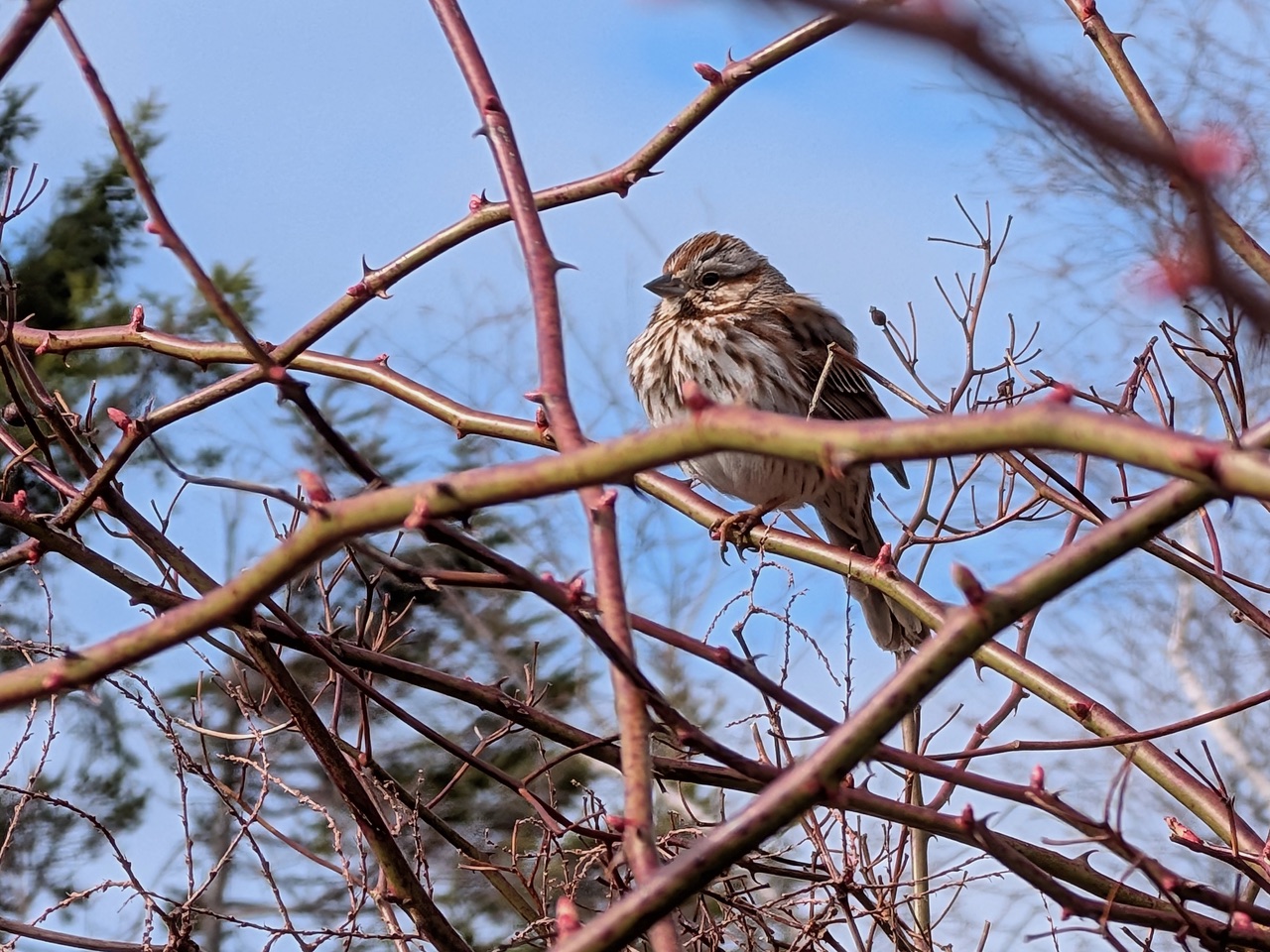
Through the winter, I’ve heard the cawing of crows and the whistles of cardinals dressed in their Christmas-y red. But my favorite by far has been the confident opening notes and trills of the song sparrows. I’ve been grateful for their cheery music, awed that the small sparrows can survive—even sing!—through icy winter weeks.
They’ve reminded me of the words Jesus spoke to his disciples as he sent them out into the world. He warned them of waiting threats, then quieted their understandable fears with this reminder:
“Are not two sparrows sold for a penny? Yet not one of them will fall to the ground outside your Father’s care. And even the very hairs of your head are all numbered. So don’t be afraid; you are worth more than many sparrows.” (Matt 10:29-31)
Listen again: “Don’t be afraid; you are worth more than many sparrows.”
You are Seen
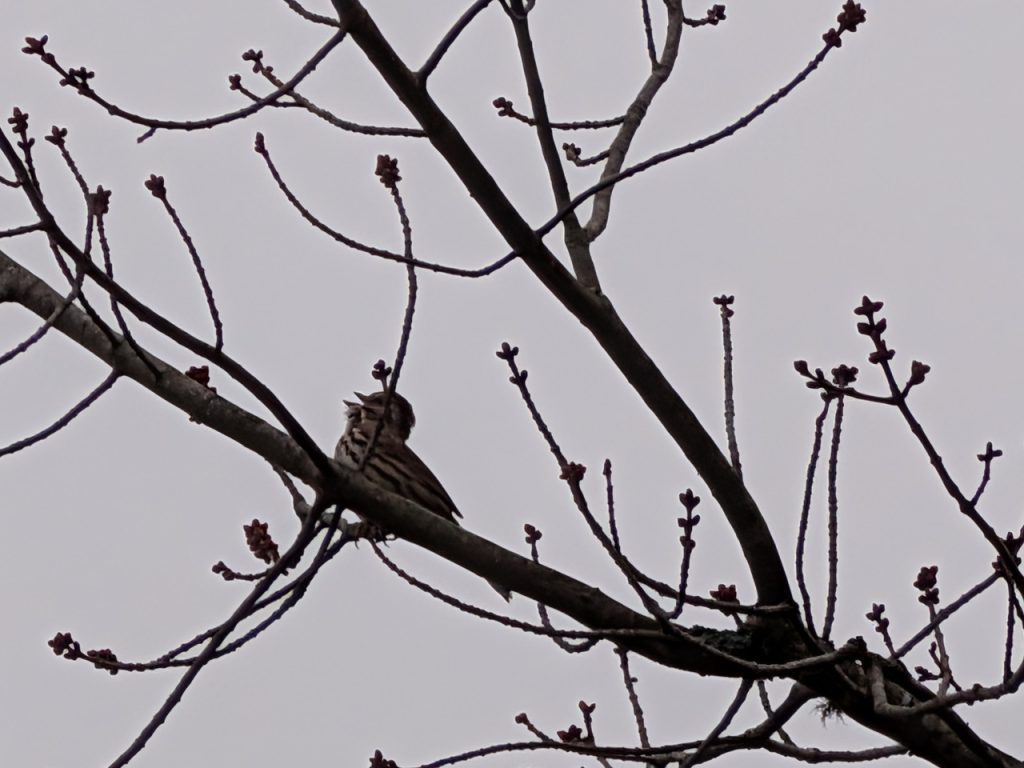
As I’ve been savoring Courtney Ellis’ beautiful book, Looking Up: A Birder’s Guide to Hope Through Grief, I’ve come to appreciate more deeply the significance of Jesus’ words about sparrows. They’re “in nearly every country on earth. There are thirty-five different types of sparrows in the United States alone, and an estimated 140 worldwide.” And just one of those species, the House Sparrow, makes up 1.6 billion of the estimated 50 billion individual birds on earth (Ellis, ch.4).
These birds are common. And that, along with their lack of flashiness, often makes us overlook them as boring.
Worse, throughout history they’ve often been seen as pests.
“In Egyptian hieroglyphs, cats and crocodiles were revered and feared, while sparrows showed up only as a determinative, added to make another word mean ‘small, narrow, or bad.’ Even their collective term is derogatory: a group of sparrows is known as a quarrel. They often snap up newly sown seeds and steal precious grain intended for people or livestock. In the late 1950s, China instituted a campaign against ‘the four pests,’ including rats, flies, mosquitoes, and sparrows” (Ibid).
In Jesus’ time, sparrows were a cheap food source for the poor, the cheapest of the birds sold for food (Tyndale Commentary on Matt 10:29).
I love that the birds Jesus chooses to highlight are sparrows. Small, ridiculously common, and easily overlooked, except when people are selling them for cheap food or trying to destroy them: These are the birds Jesus tells us aren’t forgotten by his Father. And this is such good news:
“Sparrows are . . . a reminder that God’s care is not dependent on our own transcendence or charisma or beauty. Everyone notices a peacock, but sparrows can blend in until we stop seeing them at all.
God never does” (Ellis, ch.4).
We don’t have to be flashy to be noticed by God, or beautiful to be cared for. We’re already loved with the kind of attentive tenderness that observes every endearing dimple and weary wrinkle and all the blond or black or greying hairs on our head.
But there’s more.
You Are Special
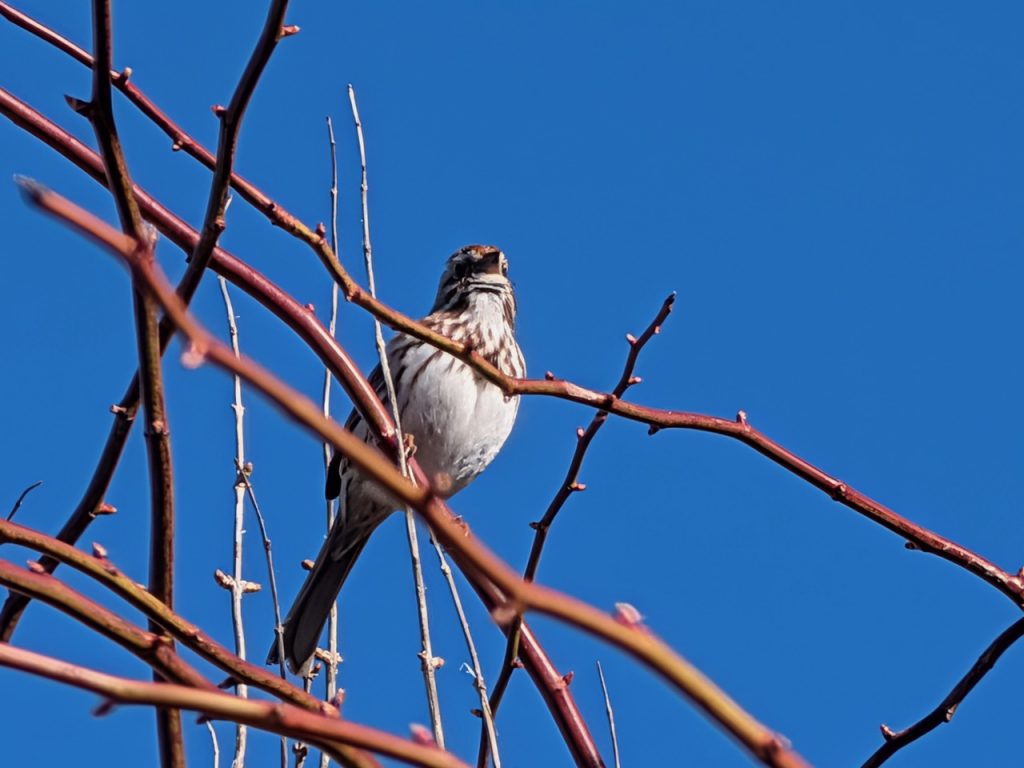
I thought I’d learned to recognize the music of song sparrows, but over these last few weeks, the song that I’d heard over and over in winter has shifted and crescendoed into a whole new series of songs and variations. Turns out that “a single Song Sparrow’s repertoire can include over two hundred different tunes. . . . Male Song Sparrows develop a thirty-minute ‘playlist’ that they will repeat or shuffle according to the preferences of nearby females” (Ibid).
These ‘common’ birds aren’t so common after all. Each one is unique and beautiful.
“It would be enough for God to create such specificity among just the human family, stamped as it is with the imago Dei, but the natural world is extended this same grace and goodness. Every tree and twig and leaf paints its own rare swath of color. No two ladybugs have the same precise pattern of spots. Birds sing their one-of-a-kind songs, particular not only to their species but fine-tuned to their geographical locations, like people’s regional accents. Each individual bird in each individual species is unique. . . .
Much of our modern economy is fueled by uniformity. . . .Sameness is profitable. It’s also rote.
But one of the marks of God’s good creation is that even seemingly indistinguishable things are never exactly the same” (Ibid).
So hear Jesus’ words again, in light of sparrows which are many and small and easily overlooked by us, but loved and tended by the One who creates each one beautifully unique, receives each song as worship, and guards each little life.
Are not five sparrows sold for two pennies? Yet not one of them is forgotten by God. Indeed, the very hairs of your head are all numbered. Don’t be afraid; you are worth more than many sparrows. (Luke 12:6-7)
Don’t be afraid. You are worth more than many sparrows.
* * *
P.S. In case you’re interested, I recently bought Looking Up on IVP’s “up to 80% off all ebooks” sale, which runs until the end of April.
Thank you Caroline! This really”hit the spot” for me today! Blessings Janice
Thanks, Janice. I’m so glad!
wow!!!! The playlist!!!!
Just in the building behind us there is a hole around where a drain pipe comes out where I’m quite sure a sparrow has laid eggs and they maybe hatched yesterday as there was a lot of noise and activity. Almost noone could see it but it’s exactly across from our back balcony. I had to stand still and watch and listen for a while to even see them where they were going in and out of the hole and standing on the end of another pipe they are so small but a gift.
Thank you for this post!!