


“What are you hoping for?” “Can you sense what’s under the anger?” “What would you like for dinner?”
Questions matter. They can invite us to look again at our assumptions, help us better understand ourselves, and lead to a more generous and compassionate loving of those around us.
“Why is the sky blue?” “Who made God?” “Where does the moon go in the morning?”
Children are masters of the fine art of asking questions that make us think. I wonder why so many of us seem to lose our facility with asking good questions as we grow up, apart from intentional work. Does it feel safer to assert our knowledge than to reveal our uncertainty? More comfortable to stay within our securely-built views than to risk the possibility of change?
“What are you looking for?” “Why are you so afraid?” “Do you want to get well?”
As Carolyn Arends points out in her sermon, “What are you looking for?” (2/18/24 ), Jesus is recorded in the gospels as having asked 307 questions. Others asked him 183 questions that are recorded, of which Jesus directly answered less than 10. Like children and the best counsellors, Jesus was—and is—a master of asking questions.
Questions Jesus Asks
Each week during Lent, our church explored one of the questions that Jesus asked his followers—and that he still asks us.
- What are you looking for? (OR What do you want?) (John 1:35-39)
- Do you believe? (John 11:1-37)
- Why are you so afraid? (Mark 4:35-41)
- Will you lay down your life for me? (John 13:31-38)
- Do you want to be made well? (John 5:1-14)
- Who do you say that I am? (Matt 16:13-20)
- And finally, on Easter Sunday, Who is it you are looking for? (John 20:1-18)
I’ve loved this series—though I admit to feeling a little nervous approaching some of the questions. They go deep. They feel vulnerable. But they’re also profoundly freeing. And as we explored each question, I was reminded all over again of the marvel that the One whose heart you and I want to know also wants to know ours. He cares—deeply—about what we want and grieve and fear as well as whether we believe and know and will follow him.
What Do You Want?
If, like me, you sometimes question whether it’s okay to pay attention to what you want, you might find Carolyn Arends’ first sermon in this series particularly helpful. It’s the most clear, helpful, and Scripture-based discussion I’ve heard about why it matters to pay attention to our desires. (You can watch or listen to her 2/18/24 sermon, “What Are You Looking For?” here.)
But sometimes what we need is simply a story of what a fellow pilgrim discovered as she dared to pray through questions like, “What do you want?” and “What makes you come alive?” My friend and fellow writer, Corella Roberts, offers a story like that in her new book, Catch the Rain: Soul Restoration for the Dry and Weary Christian. Listen in with me as she tells it?
“A CHANGE WAS COMING, AND as I stared at it from every possible angle, I could only see one outcome: I would go back into teaching. It just made sense. My youngest was about to enter kindergarten at the international school in Thailand where we came to serve. My degree was in elementary education. The need, as always, was for more volunteer teachers. How could I not?
At that time, I was in a book study group, and the author prompted us to take serious stock of our lives—our commitments, our experiences, our hopes and even our childhood dreams. I almost didn’t allow myself to go down that road. I knew it would lead to places of disappointment and that nagging sense of duty I always lived with. But walk it I did, and what I uncovered surprised me.
I was made to be a writer.
What I began to discover in that season, is that I can only offer my true self to God. Nothing else is worthy. Not who I wish I was. Not who I think He wants me to be. Not who others push me to be. Not who makes the most sense for this situation. Just me.
And just me needs more quiet space than noise. I come alive when I create something meaningful with words. Writing, for me, is a form of listening prayer that connects me to my Father’s heart like little else. If I do not draw protective lines around the time and space I need for quiet and for words, I stagnate. Shrivel, even. And I cease to offer my truest, deepest worship to God.
There’s an interconnectivity between this, my lines and my worship. My life and my offering. And, naturally, the way God can use me to touch the world. I believe this is a truth that encompasses you, too. A life lived within the bounds of who God made you to be is an act of submission to your Creator that He can use to bring His kingdom according to His design.
Lord, you alone are my portion and my cup;
you make my lot secure.
The boundary lines have fallen for me in pleasant places;
surely I have a delightful inheritance.
I will praise the Lord, who counsels me;
even at night my heart instructs me.
I keep my eyes always on the Lord.
With him at my right hand, I will not be shaken. (Psalm 16:5–8)
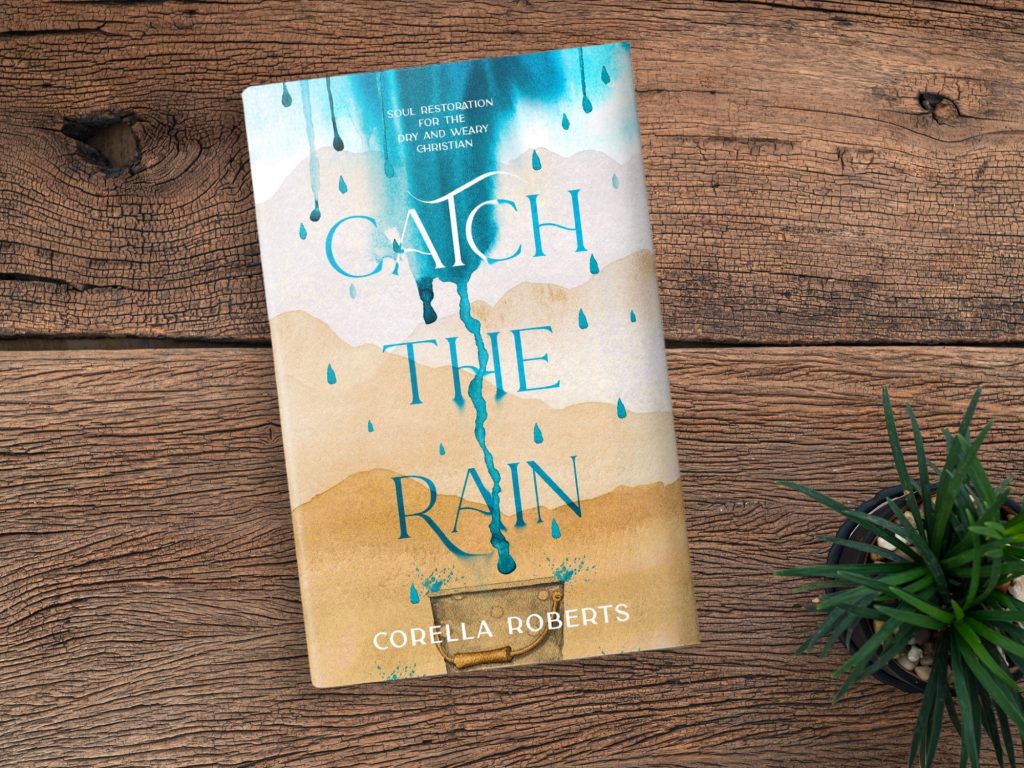
I love how Corella both recognizes the importance of our God-given desires and boundary lines, and keeps them in perspective:
“This is all much less about me than I like to think it is. It’s not about you, either. At least, not in the self-important way we often slide into in our ministry and service roles.
We serve a boundless God with unlimited resources. He does not need us to accomplish His will. But, He wants us to partner with Him by joyfully living out of our unique design. That’s where we give Him the best, the first fruits, of our service.” (Catch the Rain, p. 59-60)
So if Jesus were to ask you today, “What do you want?” how would you respond? (And if you find it scary or uncomfortable to consider that question, there might be another one for you first: What’s holding you back?)
_____________
Want to read more of Corella’s writing? You can see the trailer and download the first chapter of Catching the Rain here, purchase the book here, or sign up to receive her beautifully encouraging (and free) newsletters at corellaroberts.com.
First photo by Mehdi Mirzaie on Unsplash. Second photo by Corella Roberts.