

It’s two months today since the moving company came and packed into their van all that I was bringing from my Vancouver home to my new, old, Nova Scotian home. And it’s five weeks today since I wrote here. Sometimes, in these transitional seasons, I struggle to string together meaningful sentences, and this time is no different.
Maybe it’s partly the many tasks vying for my attention, and the need to create new rhythms and routines. But perhaps it’s also that in these liminal spaces, I often don’t see clearly. And while that can be uncomfortable, it can also be good because life and beauty often grow best in the dark. Sometimes God keeps us from fully understanding what he is doing in us so we don’t interfere with his ongoing work of creating love and freedom in us.
In these times, I need to remember that He can be trusted to create beauty. He is the One who delights to hover over formless chaos and from it shape ruby-throated hummingbirds, sun glinting on the tips of salty ocean waves, and the milky ribbon of stars in a clear winter sky.
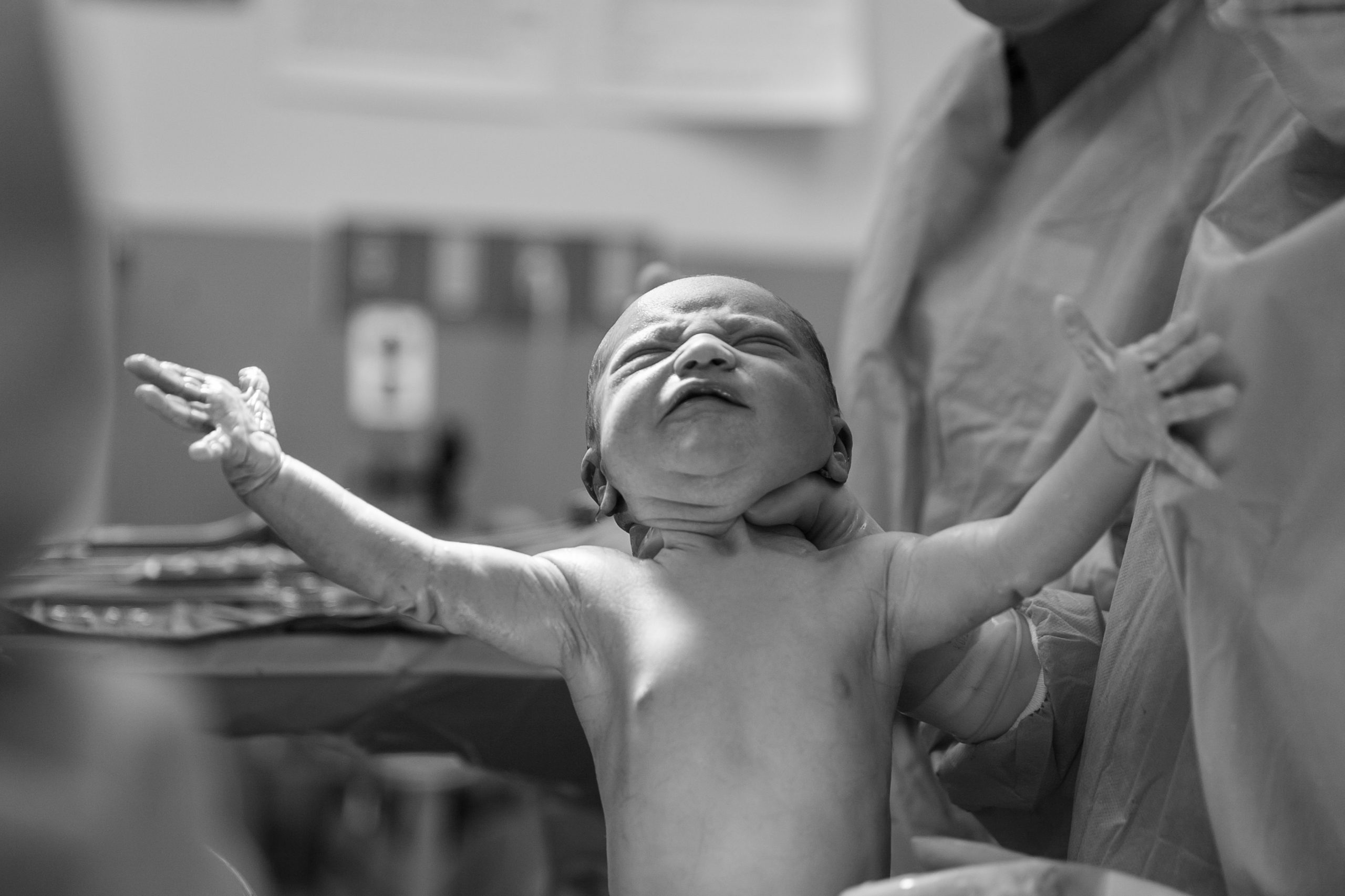
Here, too, I need to remember that new creation is seldom tidy. We see a newborn baby or the first green shoot of spring peeking up from the ground and it awakens within us hope, and tenderness, and a desire to protect the new little life. The mystery is great, and the awe, and the hope. But also the mess. Someone got dirt under their fingernails planting those bulbs. Someone made space within herself and carried that baby-in-formation through three-quarters of a year of nausea and back pain, heartburn and mood swings, weariness and the little guest tucking himself up under her ribs or kicking her bladder or doing aerobics when she was trying to sleep. Someone breathed through the pains, and soaked the carpet when the water broke, and wondered if she could do it, and gave all her strength to push this new bit of life out into the world, slippery with fluid and blood and caked with white vernix. The coming of new life is messy.
The Divine Midwife
That’s one of the reasons that the Psalmist’s understanding of God as midwife so delights me. People who choose to make their life’s work caring for women and the life coming into being through them aren’t generally afraid of the mess. Nor of the unpredictability of the process. And so in the messiest and most dangerous moments in his life, the Psalmist cries out to the divine Midwife.
In Psalm 71:6, when the Psalmist’s life is threatened by enemies, he prays, “It was you who took me from my mother’s womb.” The Hebrew text reads, “It was you who cut me from my mother’s womb,” picturing God as the midwife cutting the psalmist’s umbilical cord at his birth.
In another of the most painful times of his life, when his sense of being abandoned by God was accompanied by physical illness and exhaustion and desertion by friends, David finds hope in the reminder that the same God who was present at his physical birth, guarding his life, still tends him: “Yet it was you who took me from the womb. You kept me safe on my mother’s breast” (Ps 22:9) The Hebrew literally says, “Yet it was you who pulled me out of the womb. . . ,” picturing a midwife helping a baby be born.
It is quite possible that Jesus himself turned for comfort to the image of God as Midwife. From the cross, his raw back rubbing rough wood with each word, Jesus cries the first words of Psalm 22, “My God, my God, why have you forsaken me?”, and the writer of Hebrews quotes Jesus as speaking v. 22 in the context of his suffering (Hebrews 2:12). As a Jewish boy, Jesus would have memorized large portions of Scripture, and in his agony, this entire psalm may well have become his prayer, its poetry wrapping up all the outer details and inner wrestlings of those hours leading to his death, holding open space for trust during his excruciating birthing of us, “a people yet unborn” (v. 31), into the inner life of the Trinity. Every part of him burned: his pierced hands and feet, his dislocated joints; Jesus, along with the psalmist, may have cried that his heart had melted within him (v. 14). He was being torn apart, as though by “roaring lions that tear their prey” (v. 13).
If Jesus was indeed praying this whole psalm on the cross, then for help in the tearing, burning intensity of his labor, he turned to the divine Midwife: “Yet it was you who took me from the womb; you kept me safe on my mother’s breast. On you I was cast from my birth, and since my mother bore me you have been my God” (v. 9-10).“ In you our ancestors trusted . . . and you delivered them,” he reminded himself (v. 4). Into the skilled and gentle hands that had delivered him and thousands before him he could commit his body and spirit.
I’m intrigued that David and likely Jesus as well (both men!) found comfort in the image of God as Midwife. In Galatians 4:19, the apostle Paul addresses the recipients of his letter, “My little children, for whom I am again in the pain of childbirth until Christ is formed in you . . .” He paints a startling picture in which all Christian believers (women and men!) are pregnant and Christ is the baby growing inside of us.
It’s an incredible privilege to carry Jesus within us. But I also know from my experience as an obstetrician walking with women through their pregnancies that as much as they might love the child being formed within them, pregnancy can be frightening. Spiritual pregnancy—Christ being formed in me—can feel scary and out of my control too—particularly knowing that this One being formed in me isn’t afraid of calling me to come and die on my way into new life. When fear rises, or I’m aware of my messiness, there’s comfort in knowing I’m in good hands, being cared for by the same skilled Midwife who was there at my own birth, unseen but present and wise and tender. That midwife is still guarding my life and skillfully working to safely deliver the life that is coming into being in and through me. And in and through you.
How is it for you to consider that strong and gentle hands are holding you and all that concerns you, even in the middle of the mess? Even in the times you might not feel those hands?
Is there anything you’d like to say to your divine Midwife right now?
(An edited repost from the archives.)
Photo by Alex Hockett on Unsplash


So beautiful. Thank you for writing and sharing. So grateful for the timing. <3
You’re most welcome, Angela. I’m so glad the timing was significant for you!