


A few weeks ago, Bruce Main, while preaching at our church, told about a man who phoned him up asking if his organization could use a volunteer. Bruce asked what he did and the man replied, “I can cut grass, I can pull weeds, I can plaster holes, anything.” He offered to start the following morning.
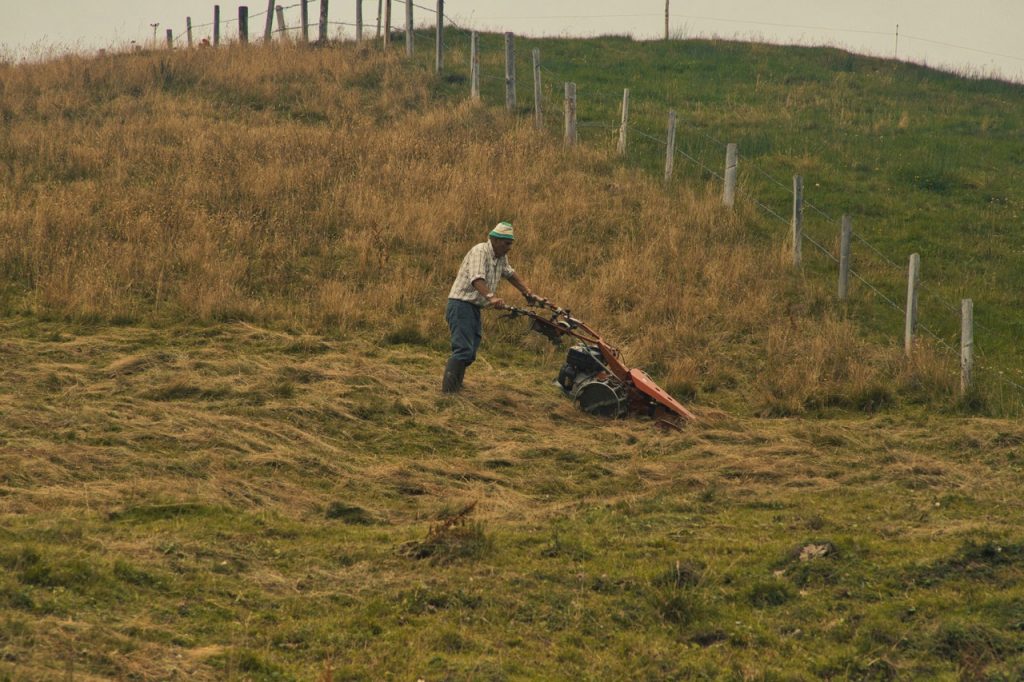
After the man had been slogging away for an hour and a half at their 18-inch-high grass in the heat and humidity, Bruce went out to thank him. The man replied, “I just lost my job. God has given me the gift of time and I wanted to share it with you.”
This man had learned the same secret as the Apostle Paul, who wrote, “I have learned the secret of being content in any and every situation. . .” (Phil 4:12).
Bruce’s statement that he has come to see contentment as a sign of spiritual maturity stuck in my mind and heart. I’ve grown in contentment, but I still have far to grow. And as I’ve been pondering and trying to live it over the past couple of weeks, I’ve found I needed to think more deeply about the “how.” Contentment doesn’t come easily to many of us. Our culture which, as Bruce said, “is built on fostering discontent” doesn’t help.
So how do we grow in contentment?
Perhaps the first question to ask is, “What underlies our discontent?” Is it simply a habit of focusing on the empty half of the glass instead of the full half? Or is there a deeper emotion like fear or grief at play?
For me, when discontent is a result of my glass-half-full habit, intentionally choosing to give thanks (often with the help of a pen and my gratitude journal) and turn my eyes to Jesus (often with the help of a Spotify worship playlist) and can turn me back not just to contentment but even further into joy.
But if there’s a deeper emotion at play, then trying to turn away from that emotion back to gratitude is seldom enough. Instead, I need to make the counterintuitive choice of turning towards that emotion in the presence of Jesus. I need to explore with Jesus what I’m afraid of, or what the layers are of the loss that I’m grieving. I need to ask how Jesus wants to be with me in those places. And there, finding myself welcomed as I am and securely enfolded in God’s gentle love, contentment has room to grow.
Sometimes, as we turn toward the discontent and the underlying emotions in the presence of Jesus, we may even discover that our discontent is a holy discontent—a grief, restlessness, longing or anger that aligns with the loving heart of God. This kind of holy discontent is a sign that God is calling us closer to his heart of love. Perhaps he’s inviting us to act with him to make a difference in a situation where injustice reigns. Perhaps he’s calling us to the humility of acknowledging our weariness and letting him help us rest more deeply in his love. This holy discontent is a gift.
Paul’s Secret
Do you see what I see? Regardless of its cause, discontent is never a call to seek contentment, but to seek Christ.
And that, it turns out, was the secret that Paul discovered:
“I have learned to be content whatever the circumstances. I know what it is to be in need, and I know what it is to have plenty. I have learned the secret of being content in any and every situation, whether well fed or hungry, whether living in plenty or in want. I can do all this through him who gives me strength” (Phil 4:11-13).
The direction of Paul’s focus is clear throughout the book of Philippians:
“For to me, to live is Christ and to die is gain” (1:21).
“I desire to depart and be with Christ, which is better by far. . .” (1:23).
“I consider everything a loss compared to the surpassing worth of knowing Christ Jesus my Lord, for whose sake I have lost all things. I consider them garbage that I may gain Christ and be found in him. . .” (3:8-9).
Paul could be content in any circumstance because he wasn’t focused on his circumstances. It’s not that he was oblivious to them. He felt the hunger pains and the cramping of his legs as he was chained to a soldier. He knew the cold spray of waves and the crunch of cracking timbers as his boat was shipwrecked, the sickening pain of the whip as it tore his flesh raw. But his focus was on Christ and the eternal glory to come.
“Therefore we do not lose heart. Though outwardly we are wasting away, yet inwardly we are being renewed day by day. For our light and momentary troubles are achieving for us an eternal glory that far outweighs them all. So we fix our eyes not on what is seen but on what is unseen. For what is seen is temporary, but what is unseen is eternal (2 Cor 4:16-18).
How did Paul keep his eyes on Christ as he sat on the prison floor, back bloody and feet in stocks? He sang and prayed with another believer who was also hurting (Acts 16:23-25).
The Psalmists do likewise. When life is falling apart, they write a song. But notice this: they don’t ignore the struggle. They don’t try to move straight from pain to praise. They come as they are, pouring out the pain to God, asking for his help. And it’s right in that place, as their hearts are lightened by honesty and their hope is rekindled by knowing they’re heard, that their eyes can shift from the problem to the One who is with them in it.
Malcolm Guite gives us a beautiful example of how this may unfold in his own poetic response to Psalm 13. He cries out. And as he encounters the wounded hands of Christ reaching to hold him in his own woundedness, hope comes, leading him into praise and opening his heart to God’s overflowing love which then spills out of him into the world.
Come down to free us, come as our true friend,
How long, how long? Oh do not hide your face
Or let me sleep in death, but light my end,
Till it becomes a bright beginning. Place
Your wounded hands in mine and raise me up
That even grief itself may turn to grace.
Then I will sing a song of sudden hope,
Then I will praise my saviour, the divine
Companion who drank the bitter cup
And in so doing made it flow with wine,
That his strong love might overrun my heart
And all his joy in heaven might be mine.
Then I will sing his song, and take my part
In Love’s true music, as his kingdom comes
And heaven’s hidden gates are drawn apart.
What about you? What has helped you grow in contentment? I’d love to hear!
First photo by Daniel Watson on Unsplash; Second photo by ASTRONAUD23 ㅤ on Unsplash.